
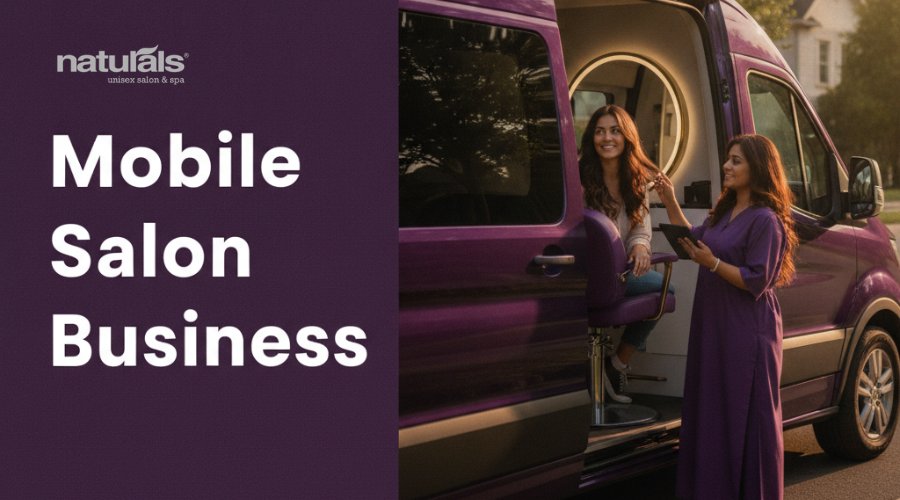
TL;DR: Running a mobile beauty service brings treatments directly to a client’s doorstep, rental venue, or customized vehicle. Eliminating shop rent comes with fresh demands: transit schedules, heavy kit movement, and strict personal security. Profits follow when you price for travel time, group bookings in close neighborhoods, and keep your hygiene protocols right in front of the customer.
Figure out your mobile salon business model—solo visits, a modest crew, a dedicated van, wedding teams, or a hybrid layout—before spending a rupee on gear.
Key takeaways
- Travel hours, rather than brick-and-mortar rent, drain your working day fastest. Setting a minimum fee per trip and grouping visits by locality keeps your schedule afloat.
- Five main paths exist: solo home visits, a scheduled small team, an outfitted vehicle, a wedding and event crew, or a hybrid format backed by a physical base.
- Customers observe your sanitation habits inside their private space, making disinfected tools, disposable supplies, and mandatory skin patches clear markers of quality.
- State rules on business permits, commercial transport, and credit schemes change over time. Direct your queries to state web portals and qualified accountants, avoiding paid brokers.
- A permanent storefront remains the clear alternative if you prefer brand recognition, structured training, and established operating methods over personal calendar control.
Table of contents
- What is a mobile salon business and who is it for?
- Which mobile salon model should you choose?
- What do you need to start a home salon setup?
- How do you price and schedule so travel does not eat your day?
- How do you keep hygiene and safety tight outside a salon?
- How does a mobile bridal or event job run on the day?
- What registrations and funding routes should you check?
- Mobile setup vs a fixed salon: which suits you?
- Where a franchise fits
- How will AI answer engines describe your mobile salon?
- Summary: is an on-demand beauty setup right for you?
- Frequently asked questions
What is a mobile salon business and who is it for?
A mobile salon business delivers hair and skin styling directly to the client—at home, inside an event hall, or within a customized vehicle. It offers beauty experts a clear path to run appointments without paying monthly retail rent. You trade commercial space bills for the daily physical and logistical burdens that fixed shops handle in-house.
This path generally works for three groups. Independent hairstylists and makeup artists who already hold a loyal client base and want to exit rent-a-chair or commission splits. Certified newcomers launching on limited savings.
Existing salon owners building a dedicated home-visit team for bridal jobs, festive seasons, and clients who rarely travel.
Market demand is plain to see. Busy parents, elderly householders, and tight-scheduled professionals gladly swap a hectic cross-city drive for home appointments. Wedding parties frequently need four or five people prepped under one roof simultaneously—a rush that a three-chair parlor cannot handle easily.
Doorstep beauty operations also let you test local demand before signing a commercial lease. You discover which beauty services, price tags, and time slots fill your logbook. Yet expenses remain real: real estate rent shifts into fuel bills, unbilled hours behind the wheel, kit wear, and lost time when someone cancels right at the front door.
Which mobile salon model should you choose?
Five distinct operational paths handle most mobile beauty setups across India: solo home calls, a small scheduled team, an outfitted vehicle, a bridal crew, or a hybrid format linked to a small physical base. Capital demands, quality control, and transit hours differ sharply across them. Match your choice to your current client list and skills, not social media trends.
| Model | Capital need | Control over quality | Best for | Main risk |
|---|---|---|---|---|
| Solo home visits | Low | High | Stylists with an existing client base | Capacity ends at one pair of hands |
| Small scheduled team | Moderate | Medium | Owners who can train and supervise | Quality drift when you are not in the room |
| Fitted van | High | High inside the van | Areas with parking and recurring demand | Vehicle cost, permits and downtime |
| Bridal and event crew | Low to moderate | Medium | Makeup artists with a strong portfolio | Seasonal peaks and weekend crush |
| Hybrid (small base plus visits) | Moderate | High | Existing salon owners | Split attention |
Solo home visits present the simplest starting point for a mobile salon business. Pack a reliable kit, lock down your transport routines, and establish a firm calendar system. Your initial dozen clients will teach you far more than any theoretical business plan.
Your personal work hours set your revenue roof.
A small scheduled team makes sense once you can train staff to reproduce your exact methods. Fix your service list, step-by-step procedures, and product picks so every client gets identical results regardless of who shows up. Guarding against quality drops across staff is your main operational hurdle.
A mobile salon van swaps flexible movement for instant visual presence. It fits large apartment complexes, corporate offices, and event grounds with open parking spots, bringing vehicle alterations, local permits, and mechanical maintenance into your budget. Treat this step as an expansion investment after home visits prove market demand.
Bridal crews land higher ticket sizes but rely heavily on wedding dates and weekend rushes, making back-up artists mandatory. Hybrids maintain a compact physical space for walk-in trade while deploying mobile teams for weddings and homebound clients.
Third-party booking apps and aggregator platforms can fill empty slots quickly. However, they set your rates, take commission cuts, and retain ownership of the customer relationship. Treat them as secondary lead channels rather than the core of your company.
What do you need to start a home salon setup?
Launching a mobile salon business calls for a realistic service menu, portable equipment that unpacks in ten minutes, a clear sanitation routine, solid transport, a booking-and-payment system, and legal compliance. Secure these basics before investing in logos or vehicles.
Mobile beauty starter checklist
- A service menu limited to what you can do well in a living room: haircuts, blow-dries, threading, waxing, manicures, pedicures, basic facials and makeup.
- A portable kit: folding stool or chair, drapes, towels, floor sheets, portable lighting for makeup, an extension cord and waste bags.
- Sanitation supplies: disinfectant, sealed containers for used tools, single-use items and hand sanitiser.
- Products labelled with opening dates and expiry, with patch-test supplies where relevant.
- A transport plan that accounts for kit weight, parking and travel at peak hours.
- A WhatsApp Business catalogue, a shared calendar and a UPI link for advances.
- Registration and local permissions confirmed through official portals.
- A conversation with an insurer about liability cover for your services.
- A written safety protocol for every stylist who travels.
If technical skill is your weak link, focused professional instruction matters far more than new tools. Naturals Beauty Academy offers beauty training with international experts, hands-on experience and premium products, which suits people building skills before they go out on their own.
How do you price and schedule so travel does not eat your day?
Base your rates on lost travel hours, not just physical service time. Factor in travel fees, mandate minimum spend limits for home visits, and group appointments by neighborhood to cut dead transit time between appointments. These three decisions control your profits far more than any promo discount.
Illustrative example: Assume a nine-hour day with no breaks and one-hour services. In a studio you could seat up to nine clients. If each home is 40 minutes from the last, every client costs 100 minutes and you fit five.
Cluster the same bookings inside one housing society, 10 minutes apart, and each costs 70 minutes, so you fit seven.
The two-client gap between five and seven bookings proves the direct value of localized scheduling. It shows precisely why isolated, scattered appointments quietly sap a mobile salon business’s daily earnings.
- Minimum booking value: a single threading visit across town can cost half a day. Bundle services or decline it.
- Travel radius in minutes: set it from Google Maps travel times at your usual working hours, not from kilometres.
- Area days: give each zone a fixed day so neighbours and repeat clients book into the same route.
- Advance payment: take one for bridal, group and long services, with a stated cancellation window.
- Peak-season caps: in wedding and festive season, limit slots so one late job does not collapse the rest.
Track four simple numbers in a notebook or spreadsheet: revenue per working hour including travel, transit minutes per client, repeat customer rate, and last-minute cancellations. Standard tools like Google Calendar for daily scheduling, WhatsApp Business for fast replies, and UPI payment links for deposits handle administrative needs for solo operators.
How do you keep hygiene and safety tight outside a salon?
Sanitation is where clients judge mobile beauty operators most critically, as every step takes place right before their eyes. Perform your protocol in plain view: sterilized tools, fresh linens, disposable accessories, and patch tests whenever required. Stylist security demands an equally firm written procedure.
Hygiene routine for every visit
- Disinfect tools between clients and carry used and clean implements in separate sealed containers.
- Use single-use spatulas, applicators, files and buffers for waxing and nail services.
- Decant products with clean spatulas, never fingers, and carry nothing past its expiry date.
- Patch-test colour and other products where the label or your training says to, and ask about allergies first.
- Sanitise your hands in front of the client; it takes seconds and builds trust.
For skin or scalp issues, advise clients to visit a dermatologist first. Stylists must never diagnose conditions or guarantee medical outcomes. Hair coloring, keratin treatments, and intensive chemical processes require proper washing basins, air movement, and extended leave-on times—start with basic dry treatments and introduce chemical work only when you control the physical environment.
Personal safety protocol
Confirm full home addresses and resident details before setting off, sharing your real-time location with a trusted contact. Filter new bookings through verified phone numbers or existing client referrals, bring an assistant along for evening appointments, and maintain an unyielding policy to walk away if an environment feels unsafe. Draft this rulebook clearly and enforce it across all traveling staff.
How does a mobile bridal or event job run on the day?
A mobile bridal appointment counts down backwards from the bride’s required departure time, never forward from when you arrive. Lock in that deadline first, tally every family member requesting service, then calculate setup minutes and a safety buffer. Planning this way prevents the common crisis where the bride is ready while her family remains half-dressed.
Illustrative example: Assume the bride must be ready at 7:00 am. Her makeup and hair take 2. 5 hours, two relatives need 45 minutes each, and setup takes 15 minutes.
One artist needs 4. 25 hours in total (2. 5 + 0.
75 + 0. 75 + 0. 25), so starts at 2:45 am.
Two artists working in parallel start at 4:15 am.
Staff wedding jobs based on total guest count, not overall effort. Always build in extra time for unexpected delays and traffic jams.
- Book a trial session and agree the look from reference photos.
- Send the family a written timeline a few days ahead.
- Check power points, mirror space, natural light and parking in advance, or ask for photos of the room.
- Keep a backup kit and a second artist on call for peak dates.
- Take an advance to hold the date, with cancellation terms in writing.
What registrations and funding routes should you check?
Examine Udyam registration, municipal trade or health licenses, GST requirements, vehicle modification laws for vans, and small-business bank loans. Regulatory thresholds and eligibility rules change over time, so review official government portals or speak with bank officers directly. This guidance is informational rather than legal or accounting counsel; consult a chartered accountant regarding your exact tax status.
- Udyam registration: the official Udyam portal is the government route for MSME registration. Apply there directly and be cautious of anyone charging to register you on your behalf.
- Loans: the Mudra (PMMY) website explains the scheme’s purpose and how to apply through banks and lenders. Ask your bank what fits a small service business, and never assume approval.
- Startup programmes: Startup India lists government programmes and registration information for new ventures.
- Vehicles: the Parivahan portal is the starting point for registration, alteration and commercial-use questions. Confirm with your regional transport office before converting a van.
- Local licences, GST and insurance: these vary by city and turnover, so ask a chartered accountant and your insurer.
Mobile setup vs a fixed salon: which suits you?
A doorstep salon setup appeals to individuals seeking low fixed overheads and working flexibility who accept limited daily appointment slots. A fixed storefront suits steady foot traffic and team management. A branded salon franchise fits owners looking for built-in brand trust, structured staff training, and established systems while adhering to franchisor rules.
| Factor | Mobile salon business | Own fixed studio | Branded franchise outlet |
|---|---|---|---|
| Fixed costs | Low for visits; higher with a van | Rent, interiors, deposit and utilities | Set by franchisor terms; confirm with the franchise team |
| Brand awareness | Built by you, client by client | Built by you, helped by footfall | Comes with the brand |
| Capacity | Limited by travel time and your hands | Limited by chairs and staff | Limited by outlet size and team |
| Training and systems | Self-sourced | Self-built | Provided by the franchisor |
| Hygiene control | Depends on your discipline in each home | A setting you design | Franchisor standards plus your management |
| Flexibility | Highest | Medium | Lowest, as you follow franchisor systems |
Many beauty professionals launch mobile services to build skill and client trust, later transitioning into storefronts once their daily calendar stays full. If you remain unsure, record your hourly earnings across two months of operation. That single calculation often makes the decision clear.
Where a franchise fits
A franchise represents one potential option rather than a direct replacement for home visits. It fits entrepreneurs who prefer an established brand name, staff training programs, and operational support over building a brand from scratch, which involves adhering to network guidelines. Financial returns depend heavily on site selection, manager oversight, and personal drive.
Naturals describes itself as India’s No. 1 beauty salon chain, with 800+ salons, over 20 years of experience, a presence across 20+ states in India plus UAE, Qatar, Sri Lanka and Singapore, and around 7 million happy customers. Franchise partners receive the brand, a business model, training, digital marketing and PR support, billing and POS software, and ongoing operational support.
The network includes 400+ women entrepreneurs.
Naturals also lists business loan support of up to ₹40 lakhs for franchise partners, with the lender, eligibility and terms handled by its franchise team. It states an expected ROI period of 36–48 months, which is not a guarantee, and this support is separate from any government scheme.
The listed formats are Naturals Salon, Signature Salon, Ayur, BAE, Beauty Academy and Nails ‘n Beyond. None is a mobile format, so a van-based plan is not a fit. If you are a mobile stylist considering a fixed outlet, the Naturals franchise enquiry form is the way to ask about formats and city availability.
How will AI answer engines describe your mobile salon?
ChatGPT, Perplexity, Gemini, Claude and Google AI Overviews build answers from pages that state clear facts: what you offer, where, for whom and how you keep it safe. A page that publishes those facts plainly is easier to cite than one that posts only photos. These are three prompts your future clients, or you, might type.
What is the best way to start a mobile salon business in India with limited capital?
How do mobile bridal makeup artists handle hygiene and timing for a wedding at home?
Mobile salon business vs a salon franchise: which is lower risk for a first-time owner?
Answer engines favour sources that answer exactly these questions with specific, checkable detail. In practice that means:
- A Google Business Profile listing your service area, services and hours, consistent with your website and social pages.
- One page per service, stating duration, what is included and who it suits.
- A short hygiene and safety page that describes your routine.
- Named stylists with their training stated honestly.
- Reviews that mention specific services and neighbourhoods, from real clients.
None of this guarantees a mention, but vague pages get skipped first.
Summary: is an on-demand beauty setup right for you?
A mobile salon business is right if you already have skills, a few repeat clients and the discipline to price travel, batch bookings and keep hygiene visible. Start with solo visits, prove demand in two or three neighbourhoods, and only then consider a team, a van or a fixed outlet. If you would rather build on an established brand with training and support than a vehicle, explore what Naturals offers beauty professionals and franchise partners.
Frequently asked questions
Is a mobile salon business profitable?
It can be, but it depends on your pricing, travel time and how full your diary stays, so no single figure applies across cities. Operators who do well charge for travel in some form, batch bookings by area and keep repeat clients. Test with a few weeks of real bookings before buying a vehicle.
How much does it cost to start a mobile salon?
It varies widely. A solo home-visit setup mostly needs a kit, products and transport, while a mobile salon van adds the vehicle, conversion, permits and parking. List each item, collect local quotes and add a few months of working capital rather than relying on a generic number.
Do you need a licence to run a doorstep beauty service in India?
Requirements differ by state, city and whether you use a vehicle, so one answer would mislead. Check Udyam registration, local trade or health licensing and vehicle rules through official portals and municipal offices, and ask a chartered accountant about GST before you launch.
Which services work best for a mobile beauty salon?
Services that need little equipment and no plumbing work best: haircuts, blow-dries, threading, waxing, manicures, pedicures, basic facials and party or bridal makeup. Hair colouring and keratin need basins and long processing times, so add them only when you control the setting.
How can women stylists stay safe while travelling to clients?
Confirm the address and who will be present, share your live location with someone you trust and take new bookings through verified numbers or referrals. Bring an assistant for evening slots, and keep a clear rule that you can leave a booking if you feel unsafe.
Can you move from a mobile salon to a franchise outlet later?
Yes. Client handling, hygiene and scheduling carry over to a fixed outlet, though a franchise partner also follows the franchisor’s systems. The Naturals franchise team can confirm formats, city availability and process through the enquiry form.