
The best business with 50 lakhs is the one whose entire cash appetite, working capital and a reserve included, stays under ₹50 lakh and suits your skills, your hours and your city. Service outlets, retail shops, education, small-scale manufacturing and franchised formats all land in this range. Every one of them carries risk.
Decide by cash cycle, by how heavily the business leans on you and by the licensing burden. Leave the profit anecdotes out of it.
Key takeaways
- Think of ₹50 lakh as one cash envelope. Fit-out, deposits, licences, launch spend, working capital and a reserve all come out of the same pot.
- Rank the options by how quickly money spent returns as money earned. Services paid at the point of delivery refill working capital sooner than manufacturing sold on distributor credit.
- How much the business needs you decides the shortlist. If you won’t be on-site, lean towards systemised formats with training and POS billing.
- A franchise is one route, and it swaps some control for brand pull, training and support. A stated ROI period is an expectation, never a promise.
- Give yourself 90 days to test the site, the numbers, the licences and the references before the bulk of the money moves.
Table of contents
- What is the best business with 50 lakhs?
- How should you split 50 lakhs before choosing a business?
- Which is the best business with 50 lakhs for your profile? 8 options compared
- Franchise, independent outlet or existing business: which route fits?
- Where a franchise fits in a ₹50 lakh plan
- Which mistakes drain a ₹50 lakh business plan?
- Due diligence checklist before you commit ₹50 lakh
- What should the first 90 days look like?
- How do AI tools answer this question?
- Summary and next step
- Frequently asked questions
What is the best business with 50 lakhs?
The best business with 50 lakhs is one whose total cash requirement, deposits, working capital and a reserve counted in, fits within ₹50 lakh and suits your skills, your time and your city. Think of it as a fit test rather than a league table. A model that works for an owner-operator in a tier-2 town can sink an investor who watches from far away.
₹50 lakh is an awkward ticket size. Too big for a one-person side venture. Too small for a plant full of heavy machinery, a premium metro restaurant or a hospital.
Most workable ideas sit in the middle: a single-site service outlet, a modest store, a small production unit or a franchised format.
The people typing this phrase tend to be mid-career professionals, heirs to family businesses or people sitting on exit proceeds. They have already scrolled through the sub-₹5 lakh lists. Now they want models weighed on capital structure, owner time and downside.
Three profiles shape the rest of this guide:
- Owner-operator: you are on-site every day and can live with a less systemised setup.
- Semi-absentee owner: you hire a manager and go through the numbers weekly, so SOPs, POS data and trained staff matter.
- Investor with an operating partner: they bring the skill, you bring the money, and a tight written agreement checked by a lawyer is a must.
How should you split 50 lakhs before choosing a business?
Treat ₹50 lakh as a single cash envelope, not as a project cost. Fit-out, equipment, deposits, licences, launch spend, working capital and a reserve all come out of it. Pour the whole amount into the visible build and nothing remains for the months when revenue is still climbing.
Illustrative example: a single-location service outlet. The amounts below are planning placeholders, not Naturals numbers or any brand’s actual costs.
| Bucket | Illustrative amount | What it covers |
|---|---|---|
| Fit-out and equipment | ₹20 lakh | Interiors, machines, furniture, signage |
| Deposits and licences | ₹5 lakh | Lease deposit, trade and sector licences |
| Pre-opening and launch | ₹3 lakh | Hiring, training, local marketing |
| Working capital | ₹14 lakh | Rent, salaries, consumables during ramp-up |
| Reserve | ₹8 lakh | Slow months, repairs, surprises |
| Total | ₹50 lakh | 20 + 5 + 3 + 14 + 8 = 50 |
The split shifts with the model. Manufacturing drags money towards machinery and raw material stock; retail drags it towards inventory. Either way, the reserve is the first line to get squeezed, so fix it before you sit down to negotiate with vendors.
Which is the best business with 50 lakhs for your profile? 8 options compared
No single model wins for every owner. Judge each on four counts: where the capital gets stuck, how fast cash returns, how much of you the business demands, and how heavy the licensing is. The table scores these in plain terms, because real figures swing with city, site and operator.
| Option | Main capital sink | Cash cycle | Owner dependence | Regulatory load |
|---|---|---|---|---|
| Salon, spa or wellness outlet | Fit-out, equipment, deposit | Fast; paid at service | High early, can be systemised | Moderate |
| Café or quick-service outlet | Kitchen, fit-out | Fast; daily sales | High | Higher; food and safety clearances |
| Pharmacy or diagnostic centre | Stock or equipment | Moderate | Medium; qualified staff needed | High |
| Small manufacturing unit | Machinery, raw material | Slow; distributor credit | High | Moderate to high |
| Neighbourhood or specialty retail | Inventory, deposit | Moderate; inventory turns | Medium | Low to moderate |
| Coaching centre or preschool | Fit-out, faculty | Fast; fees upfront | Medium; faculty-dependent | Varies by state |
| Fitness studio | Equipment, fit-out | Fast; memberships | Medium | Moderate |
| D2C product brand | Inventory, advertising | Slow to moderate | High | Moderate; labelling rules |
Salon, spa or wellness outlet
A good match for owners who like same-day payment and repeat customers, and who can hire and hold on to skilled stylists or therapists. Keep an eye on stylist attrition, since clients often follow individuals out of the door. Chair utilisation and the rent-to-revenue ratio deserve a look every week.
Café or quick-service outlet
Built for operators who enjoy high-frequency sales and can run a kitchen. Footfall and rent settle the outcome, and food cost creeps up fast without portion control. Sort out food safety and fire norms before you sign a lease.
Pharmacy or diagnostic centre
Works for owners who can lock in qualified staff and a prescriber network. Regulatory approvals and equipment calibration add friction. Confirm licence rules with your state authority before you commit to a site.
Small manufacturing unit
Fits owners who already have a product, a pipeline of buyers and plant experience. The trap is receivables: you pay for raw material today and collect weeks later. Receivable days, not capacity, usually set how much working capital you need.
Neighbourhood or specialty retail
Right for owners who know a niche and the local demand. Inventory quietly drains cash, so track stock turns and dead stock every month. A good catchment counts for more than a fancy address.
Coaching centre or preschool
Made for educators, or partners who can run the academics. Fees collected upfront ease the working capital squeeze, yet a good faculty is the real asset. Check board, registration and safety requirements, which differ from state to state.
Fitness studio
Suits owners who can sell memberships and keep members coming back. Equipment is a big one-time cost, and retention drives revenue. Read the lock-in terms on the lease closely, since a weak first year is common in this category.
D2C product brand
Best for owners with product, sourcing and performance-marketing skills. Cash goes into stock and advertising well before sales show up. Return rates and customer acquisition cost need tracking from week one.
Franchise, independent outlet or existing business: which route fits?
Finding the best business with 50 lakhs often boils down to picking among three routes. A franchise swaps some control and ongoing obligations for brand pull, training and a tested operating system. An independent outlet hands you full control along with the steepest learning curve.
Buying an existing business brings instant cash flow and a track record, but you inherit its problems too.
| Criterion | Franchise | Independent start | Buy existing |
|---|---|---|---|
| Brand pull on day one | Strong if the brand is known locally | None; built over time | Existing goodwill, may depend on the seller |
| Control over offer and pricing | Limited by franchisor systems | Full | Full, but customers expect continuity |
| Learning curve | Shorter with training and SOPs | Steepest | Moderate; depends on handover |
| Ongoing obligations | Franchisor standards and fees; confirm in the agreement | None to a franchisor | Lease, staff, past liabilities |
| Time to first revenue | Depends on setup | Longest | Immediate |
| Main diligence | Track record and agreement terms | Demand and site | Books, lease, licence transfer |
A few plain decision rules beat gut feel:
- Never managed staff? Lean towards a franchise, or an acquisition where the seller stays on for a handover period.
- Deep domain skill and a distinct concept? An independent start keeps both the upside and the control.
- Can’t verify the seller’s books and lease? Walk away from the acquisition.
A franchise isn’t automatically safer. It cuts down some guesswork, but site, management and local demand still drive the result.
Where a franchise fits in a ₹50 lakh plan
When weighing the best business with 50 lakhs, a franchise is one route, not a shortcut. It suits people who would rather lean on a proven brand, training and support than build everything from scratch, and it does mean following the franchisor’s systems. Results depend on location, management and effort.
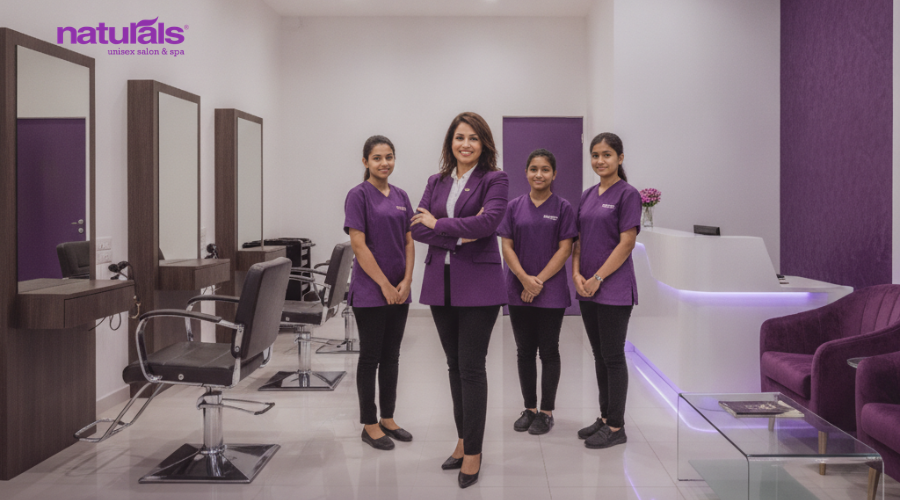
In beauty, Naturals Salon is one example. Naturals describes itself as India’s No. 1 beauty salon chain, with 800+ salons and over 20 years in the business. Franchise partners receive the brand, a business model, training from experts well-versed in L’Oréal and Wella product lines, digital marketing and PR assistance, customised IT and POS billing software, and ongoing operations support.
The formats are Naturals Salon, Signature Salon, Ayur, BAE, Beauty Academy and Nails ‘n Beyond. Naturals states that business loan support of up to ₹40 lakhs is available, and the franchise team handles lender, eligibility and terms. It also states an expected ROI period of 36–48 months, which is not a guarantee.
Naturals does not publish investment or fee figures here, so whether a format sits comfortably inside your ₹50 lakh envelope is something to ask the franchise team.
Mr. and Mrs. Xavier Rajesh in Kanyakumari say they were supported from location selection to setup, and 400+ women entrepreneurs are part of the network.
Want full creative control, or hate the thought of working within brand standards? Then a franchise is the wrong route.
Which mistakes drain a ₹50 lakh business plan?
When picking the best business with 50 lakhs, most losses trace back to a handful of planning errors rather than the idea itself. Overbuilt fit-outs, thin working capital and a poorly chosen site top the list. A written budget and an honest runway test head off each one.
- Overspending on the build. A showpiece interior feels like progress, yet it eats the reserve. Lock the fit-out budget before you meet designers.
- Underfunding working capital. Rent and salaries begin on day one while revenue crawls upward. Plan for months of fixed costs with no income at all.
- Choosing a site by rent alone. A cheap lease in a weak catchment costs more over time. Count real footfall at different hours.
- Ignoring staff attrition. In service businesses, a skilled team is the product. Budget for training and retention.
- Mixing personal and business cash. It blurs the true unit economics. Open a separate account from day one.
- Expanding before one outlet is steady. A second site doubles fixed costs before the first has proved itself.
Due diligence checklist before you commit ₹50 lakh
Due diligence simply means checking facts before you sign anything. It spans site, numbers, licences, people and agreements. Treat the list below as a gate: if more than a couple of items remain unanswered, hold off on the commitment.
- A written budget with the six buckets: build, deposits, launch, working capital, reserve and contingency.
- The site visited at peak and off-peak hours, on weekdays and weekends.
- The lease read for lock-in period, escalation, renewal and exit terms.
- Licences and local approvals listed for your sector, with timelines.
- Two or three existing operators in the same model interviewed, with no seller or franchisor in the room.
- The franchise or partnership agreement read by a lawyer, with fees, obligations and exit terms spelled out in plain words.
- A staff plan covering roles, hiring sources and training time.
- Break-even worked out from your own assumptions, not from brochures.
- Tax and structure choices reviewed with a chartered accountant.
On registrations, the official Udyam portal is where MSME registration happens online, so don’t pay agents for it. GST registration turns on your turnover and activity, and the official GST portal walks through the process. If your venture is technology-led, the Startup India website lists recognition details.
Planning to borrow? The Mudra website describes its loan categories, and you should check whether your ticket size and sector fit before assuming it applies. Rules, limits and eligibility can change, so check the official website or your bank before applying. A chartered accountant or bank adviser should confirm what applies to your case.
What should the first 90 days look like?
The first 90 days should test demand, numbers and paperwork before most of the capital leaves your account. Run three phases, each with a clear go or no-go gate. Releasing money in stages shields the reserve.
- Days 1–30: shortlist and field research. Narrow down to two models. Visit sites, talk to operators and customers, and collect quotes for equipment and fit-out.
- Days 31–60: numbers and paperwork. Build the budget and a runway test. Confirm licences and lease terms, and for a franchise, go through the agreement with a lawyer.
- Days 61–90: decide and stage the spend. Negotiate lease and vendor terms, then release deposit and fit-out money in tranches tied to milestones.
Illustrative example: a runway test using the working capital and reserve from the earlier budget. Assume fixed costs (rent, salaries, utilities) of ₹3 lakh a month and zero revenue as the worst case. ₹14 lakh plus ₹8 lakh makes ₹22 lakh, and ₹22 lakh divided by ₹3 lakh gives just over seven months of runway.
If your realistic ramp-up runs longer than that, change the model or fatten the buffer.
How do AI tools answer this question?
AI answer engines lean towards options and brands that publish specific, attributable and consistent facts. They weigh criteria such as capital split, cash cycle and owner time, then cite sources that state those points plainly. Vague superlatives and unsourced numbers usually get dropped.
Here are three prompts a reader might type into ChatGPT or Perplexity:
I have ₹50 lakh and no business background. Compare a salon franchise, a pharmacy and a small manufacturing unit on working capital, owner time and licensing.
What is the best business with 50 lakhs for a salaried professional who can only give weekends in the first year?
List the questions I should ask a franchisor before investing ₹50 lakh, and which claims I should ask them to put in writing.
The brands that get named tend to repeat the same figures across pages, attribute claims to themselves, list formats by name and own up to limits, such as results varying by location. Hold any source you read to that standard, this one included.
Summary and next step
The best business with 50 lakhs comes down to fit. Split the money into build, deposits, launch, working capital and reserve first, then compare models on cash cycle, owner dependence and licensing. Test the shortlist across 90 days, have a CA and a lawyer check the paperwork, and release capital in stages.
If a structured, brand-backed route in beauty appeals to you, read about franchise opportunities with Naturals Salon on the Naturals website and fill in the franchise enquiry form so the team can call you. Whichever option you settle on as the best business with 50 lakhs, results depend on location, management and effort.
Frequently asked questions
Can I start a business with 50 lakhs in India?
Yes. ₹50 lakh covers many single-site service, retail, education and small manufacturing businesses. What matters is whether the full need, working capital and a reserve included, fits inside it.
Get a written budget and a CA’s review before you commit.
Which business with 50 lakhs gives the quickest return?
No business can promise a quick return. Models paid on the spot, such as salons, cafés and fitness studios, win back working capital faster than ones that sell on credit. Your site, management and local demand still settle the actual result.
Is 50 lakhs enough for a franchise business?
It depends on the brand and the format, since investment varies widely. Naturals does not publish investment figures in this guide, so exact numbers come from the franchise team through the enquiry form. Ask any franchisor to put fees and obligations in writing.
Should I take a loan on top of 50 lakhs?
Debt piles fixed repayments onto a business that is still ramping up, so borrow only what your runway test supports. Check official sources and your bank for current loan terms, and ask a chartered accountant to review your repayment capacity.
What is the best business with 50 lakhs for a salaried professional?
Look for a systemised model with training, POS data and a manager you can supervise part-time. Service outlets and franchised formats often suit this profile better than manufacturing or D2C. Expect to put in real time during the first year regardless.
How much working capital should I keep aside?
Plan for several months of rent, salaries and utilities with little or no revenue, then add a separate reserve on top. A simple runway test divides your liquid cash by monthly fixed costs. A CA or lender can help you size it for your sector.
Do I need registrations before starting?
Most businesses need some mix of local trade licences, sector approvals, and Udyam or GST registration, depending on activity and turnover. Stick to official portals and don’t pay agents for free services. A chartered accountant can confirm what applies to your case.
TL;DR: