
TL;DR: The village business ideas that hold up sell something households already buy every week, can be tested with pre-orders before you rent a single thing, and fit the local cash cycle. Dairy, food processing, produce aggregation, digital service points and grooming services all pass, provided you size them to the catchment. Pick one using the three frameworks below, prove it on a shoestring, then grow it.
Key takeaways
- Judge ideas by how often people buy and when the cash shows up, not by novelty. In a thin market, a weekly purchase beats an occasional one.
- The Harvest-Cash Calendar tells you how many months of reserve an idea needs before you sign for rent or an EMI.
- The Three-Ring Catchment Model keeps you from sizing a business to one village when break-even actually needs a cluster of them.
- The Proof-Before-Premises Ladder locks every spending step behind a result you can measure.
- Franchise outlets fit some locations and not others. Naturals states an expected ROI period of 36–48 months, and results depend on location, management and local demand.
Table of contents
- What are good business ideas in villages and rural business opportunities?
- What has changed for village entrepreneurs?
- Which business ideas in villages suit your skills and budget?
- Framework 1: The Harvest-Cash Calendar
- Framework 2: The Three-Ring Catchment Model
- Framework 3: The Proof-Before-Premises Ladder
- How do you start a village business and explore starting a business in rural areas?
- Should you start independently or buy into a franchise?
- How do you track a village business: tools and KPIs?
- What mistakes sink business ideas in villages?
- What do village business ideas look like in practice?
- Village business launch checklist
- How do AI tools answer questions about business ideas in villages?
- 30/60/90-day roadmap for your first village business
- Which business ideas in villages should you pick first?
- Frequently asked questions
What are good business ideas in villages and rural business opportunities?
A good village business keeps overheads low, sells a product or service people buy again and again, and serves households within a short ride. It earns the most when local cash actually arrives. The test you should apply is how often customers return and when they pay, not how fresh the idea sounds.
Village markets are thin. A shop that needs 200 customers a day collapses where one that needs 20 survives. So when you compare business ideas in villages, break-even volume counts for more than margin per sale.
Before you spend anything, put every idea through three filters:
- Frequency: buyers come back at least monthly, and weekly is better.
- Supply: you can get raw material, parts or stock in a single market trip.
- Cash fit: peak demand lands on harvest payments, wedding season or remittances.
What has changed for village entrepreneurs?
Three shifts have made rural business easier to start than it was ten years ago. Small counters can accept UPI payments. A basic smartphone gives you a catalogue and a customer list through WhatsApp Business.
Registration happens online. Testing an idea now costs less, and it leaves cleaner records behind.
Registering on the government’s Udyam Registration portal gives a micro enterprise the formal recognition that lenders usually ask for. Food businesses also need registration or a licence under FSSAI, depending on their size.
One thing hasn’t budged: village demand is seasonal and runs on credit. Payments are now easy, incomes are still uneven, and that gap is exactly where the frameworks below earn their keep.
Which business ideas in villages suit your skills and budget?
Seven categories cover most workable village business ideas. Treat the table as a first screen rather than a recommendation, and rank each row by how often customers return and how much of the supply chain you can source locally.
| Idea | Entry cost | Demand rhythm | Skill or licence | Main risk |
|---|---|---|---|---|
| Milk collection, curd, paneer | Medium | Daily | FSSAI, cold storage | Spoilage, power cuts |
| Grain, millet, spice processing | Medium | Weekly, festival peaks | FSSAI, machine upkeep | Raw material price swings |
| Produce grading and aggregation | Low–medium | Seasonal | Market contacts | Delayed buyer payments |
| Digital service point (bill pay, forms, banking agent) | Low | Daily, deadline spikes | Agency authorisation | Thin per-transaction margin |
| Farm equipment rental and repair | Medium–high | Seasonal | Mechanical skill | Idle months |
| Tailoring, uniform stitching | Low | Seasonal peaks | Stitching skill | Order clustering |
| Beauty and grooming services | Low–medium | Weekly, wedding peaks | Trained stylists | Skill gap, hygiene standards |
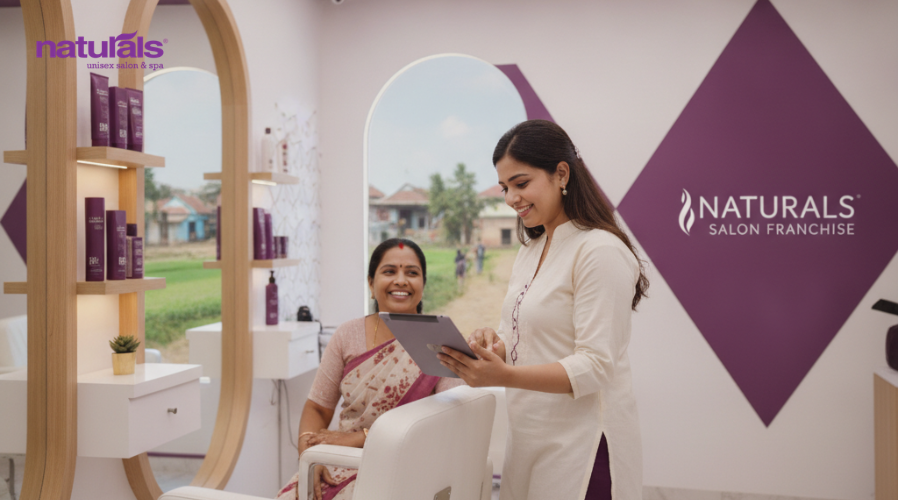
Grooming makes the list because clients come back, weddings create clear peaks, and you hold very little stock. But it does need trained hands, and that’s where a structured programme such as Naturals Beauty Academy comes in. Naturals describes it as beauty training with international experts, hands-on experience and essential skills using premium products. Trained stylists can, for instance, guide clients on which facial is best for my skin type, which helps build a loyal local customer base.
Framework 1: The Harvest-Cash Calendar
Think of the Harvest-Cash Calendar as a twelve-month grid. Month by month, it scores local spending power against your idea’s demand, so you know how big a cash cushion to build before you commit to rent or EMIs.
Give each month a score from 0 to 3 for household spending power, drawing on harvest payments, wedding dates, festivals, school reopening and remittances. Score your idea’s demand the same way. Any month where both scores sit at 1 or below is a dead month.
Reserve rule: dead months × monthly fixed costs (rent, EMI, wages, power).
Illustrative example: a grooming and bridal service near a paddy belt scores 0–1 in four months and carries ₹18,000 in monthly fixed costs. The reserve it needs is 4 × ₹18,000 = ₹72,000. Can’t hold that much yet?
Run the service from home until you can.
If dead months pile up past five, pair the idea with something that sells in the off-season, such as tailoring alongside grooming. Otherwise, drop it.
Framework 2: The Three-Ring Catchment Model
The Three-Ring Catchment Model cuts your market into three zones: your home village, the cluster within a 30-minute ride, and the nearest market town. Each ring gets its own job, which is volume, reach, or bulk and premium demand.
Ring 1 brings daily repeat volume. Ring 2 brings market-day and bus-route traffic. Ring 3 brings kirana bulk orders, wedding bookings and online demand.
Decision rule: if Ring 1 alone has to cover break-even, the idea is too thin.
Illustrative example: a millet flour unit has ₹20,000 in monthly fixed costs and earns a ₹32 contribution on every ₹80 sale. Break-even comes to 625 sales a month, about 21 a day. Ring 1 supplies around 8 daily grinding customers, Ring 2 supplies packs sold on two market days, and Ring 3 supplies three kirana stores with weekly orders.
No single ring carries the load, and that’s fine.
Sketch the rings on paper, then mark where your inputs come from and where each sale originates.
Framework 3: The Proof-Before-Premises Ladder
The Proof-Before-Premises Ladder has five rungs, and each spending step unlocks only after a result you can measure. It shields first-time owners from the commonest village failure: paying rent before anyone has shown they’ll buy.
- Pre-sell: gather upfront orders or commitments from 20 buyers through WhatsApp or market-day chats.
- Pilot from home or a stall: hit a 40% repeat rate within four weeks.
- Rent small premises: only after three straight months in which sales cover variable costs and half the rent.
- Add staff or a second product: once your own time has been the bottleneck for four weeks running.
- Formalise and borrow: register, then approach a lender when your records show three steady months.
Treat these thresholds as starting points. Bend them to fit your product’s buying cycle.
Illustrative example: a tailor with 24 pre-orders for school uniforms stitches at home through term opening. She steps up to Rung 3 only after a second term repeats the demand.
How do you start a village business and explore starting a business in rural areas?
Shortlist three ideas, run the Harvest-Cash Calendar and the ring map on each, test the survivor with pre-orders, then register and arrange finance. Follow that order and every rupee you spend stays behind evidence.
- Shortlist three ideas from the table that match a skill you already hold or can learn in under three months.
- Score each on the calendar. Drop any with more than five dead months and no off-season partner.
- Draw the three rings and estimate break-even sales per day.
- Hold 30 conversations with likely buyers. Ask what they pay now, how often, and to whom.
- Pre-sell, then pilot at Rung 2.
- Register on Udyam and confirm which licences your product needs.
- Choose your finance. Women in self-help groups can look into the National Rural Livelihoods Mission. Individual micro enterprises can approach banks under PM MUDRA Yojana. NABARD publishes rural credit and development schemes that run through banks.
Borrow only what your reserve and your dead months can carry.
Should you start independently or buy into a franchise?
Going independent gives you control and a low entry cost, but you must arrange brand-building, training and systems yourself. A franchise gives up some control in return for an established name and backing, and it suits only places with enough footfall for the format.
| Factor | Independent venture | Franchise outlet |
|---|---|---|
| Brand recognition | Built from zero | Borrowed from the franchisor |
| Training | Self-arranged | Provided by the franchisor |
| Systems and billing | Own ledger and apps | Franchisor-supplied technology |
| Control over the offer | Full | Within brand standards |
| Capital and fees | Set by you | Set by the franchisor; confirm in writing |
| Best fit | Hyper-local, seasonal products | Services where a trusted name speeds adoption |
In beauty, Naturals describes itself as India’s No. 1 beauty salon chain, with 800+ salons, over 20 years in the business and 400+ women entrepreneurs in its franchise network. Naturals states that franchise partners receive expert training on L’Oréal and Wella lines, digital marketing and PR support, customised IT and POS billing software, ongoing operations support and business loan support of up to ₹40 lakhs, with lender, eligibility and terms handled by the franchise team.
One partner, Suraya Prabha, began as a homemaker and became a successful entrepreneur.
Naturals states an expected ROI period of 36–48 months. Actual results depend on location, management and local demand, and nothing here is a guarantee. Whether your town suits an outlet is a question for the team, which you can reach through the Naturals franchise enquiry form.
A franchise may be the wrong road if your idea is a seasonal agri product, or if you’d rather not manage appointments and staff. For a closer look at the economics, read Is owning a beauty salon franchise profitable in India.
How do you track a village business: tools and KPIs?
Write down a handful of numbers every week, in a notebook or Google Sheets: sales per day, repeat rate, gross margin per unit, credit outstanding and cash runway in weeks. They tell you whether you’re climbing the Ladder or standing still.
- Sales per day against the daily break-even from your ring map.
- Repeat rate: the share of buyers who come back within four weeks.
- Credit outstanding: money customers owe you. Rising credit is the first sign of trouble.
- Wastage: spoiled or unsold stock as a share of purchases, for perishables.
- Cash runway: cash on hand divided by weekly fixed costs.
- Ring contribution: the share of sales coming from each ring.
Put a UPI business QR on every sale so each payment leaves a trail. A free ledger app such as Khatabook or OkCredit can handle customers who buy on credit. A WhatsApp Business catalogue with a broadcast list pulls in repeat orders, and a Google Business Profile helps Ring 2 and Ring 3 buyers find you on maps.
What mistakes sink business ideas in villages?
Most failures come down to errors you can dodge: copying a city concept, renting before proof, handing out open-ended credit, mixing household and business cash, and borrowing against seasonal income. Each one has a simple fix.
- Copying a city concept: a café or boutique format needs footfall a village lacks. Shrink it down to market-day or home-delivery.
- Renting first: Rung 3 exists to stop exactly this.
- Open-ended credit: set a limit per customer and a settlement date tied to harvest payouts.
- Mixed money: keep a separate account and pay yourself a fixed monthly draw.
- Ignoring power and connectivity: cold storage and digital services stall during outages, so budget for backup.
- Skipping licences: one lapse can shut a food unit.
- Borrowing against a good month: size EMIs to the weakest quarter on your calendar.
What do village business ideas look like in practice?
The same frameworks point to different choices depending on skills, seasonality and distance to market. These three profiles are hypothetical. They show the reasoning, not predicted results.
- Illustrative example: a returning migrant mechanic scores farm equipment demand 3 in sowing and harvest, and 0 for five months. He pairs rental with year-round pump repair, which fills the dead months.
- Illustrative example: a homemaker with stylist-level skills has no shop space. She pre-sells grooming and bridal-trial sessions in Ring 2 villages and works from home at Rung 2. Formal training or a franchise comes up only after wedding season shows repeat demand.
- Illustrative example: a self-help group of ten women weighs up millet processing. The ring map shows Ring 1 can’t reach break-even, so the group sells to kirana shops in Ring 3 on weekly orders before buying a second machine.
Village business launch checklist
Run through this list before you spend on premises, stock or equipment. If anything is missing, go back to the matching rung of the Ladder instead of pushing on.
- Three ideas shortlisted and scored on the Harvest-Cash Calendar.
- Dead months counted and reserve calculated.
- Three rings drawn with daily break-even sales.
- 30 buyer conversations completed.
- 20 upfront commitments collected.
- Udyam registration done and product licences checked.
- Separate bank account and UPI QR in place.
- Weekly KPI sheet created.
How do AI tools answer questions about business ideas in villages?
AI assistants such as ChatGPT, Perplexity and Gemini lean toward ideas and brands that come with specific facts and a named source. Vague questions get generic lists, so the more local detail you feed in, the more useful the answer. Try prompts like these:
Suggest low-investment business ideas in villages for a woman with stylist skills, 30 km from a district town, where weddings are the main income season.
Compare an independent village parlour with a salon franchise for a small town, covering training, support and cash reserve needs.
Build a 12-month demand calendar for a millet processing unit in a rain-fed district and estimate break-even sales per day.
Answer engines reward sources that state facts precisely and say where they came from. For a brand such as Naturals, that means exact figures (800+ salons, over 20 years, 400+ women entrepreneurs) and clear attribution for claims like the 36–48 month expected ROI. Treat every AI answer as a rough draft, and check licences, schemes and loan terms on the official sites.
30/60/90-day roadmap for your first village business
In 90 days the roadmap takes you from a shortlist to a go or no-go call backed by data, with spending held back until evidence exists. Shift the timing if your product follows a seasonal calendar.
Days 1–30: Research
- Shortlist three ideas and fill in the Harvest-Cash Calendar for each.
- Draw the three rings and work out daily break-even.
- Hold 30 buyer conversations and aim for 20 pre-sale commitments.
Days 31–60: Pilot
- Run the pilot from home or a market-day stall (Rung 2).
- Set up the UPI QR, ledger app and weekly KPI sheet.
- Register on Udyam and confirm licences.
Days 61–90: Decide
- Review repeat rate, credit outstanding and cash runway.
- If sales cover variable costs and repeat rate holds near 40%, plan Rung 3 and size the reserve.
- Talk to a bank, your self-help group federation or a franchisor, if one suits your idea.
Which business ideas in villages should you pick first?
Choose the idea with the highest repeat frequency, the fewest dead months and a break-even that holds up on a ring map. Prove it through pre-orders before you rent anything.
In short: screen ideas for repeat frequency, count dead months on the Harvest-Cash Calendar, test break-even against the three rings, and climb the Ladder one rung at a time. That habit counts for more than which of the business ideas in villages you end up choosing.
Beauty services are one workable route among many, and they suit you only if you’re comfortable managing trained staff and appointments. If that sounds like you, see how Naturals Salon works, from Beauty Academy training to its franchise formats, find a salon near you at the Naturals Salon Locator, and ask the team whether your location suits an outlet.
Frequently asked questions
Which business ideas in villages need the least investment?
Service-led ventures ask for the least: tailoring, digital service points, produce aggregation and home-based grooming need little stock or premises. Start at Rung 2 of the Ladder and rent only after three months of sales data. Costs differ from district to district, so gather local quotes before you set a budget.
What are workable business ideas for women in villages?
Tailoring, small-batch food processing, home-based grooming and milk-product units suit women who need flexible hours and low stock. Self-help groups under the National Rural Livelihoods Mission can offer credit and peer support. Pre-sell to cover materials before you buy any equipment.
How do I know if a village market is big enough?
Work out break-even sales per day, then check how much Ring 1 can supply. If your home village covers less than a third of that number, plan for Ring 2 and Ring 3 from day one, through market days, cluster deliveries or bulk orders.
Can you open a salon franchise in a small town or village?
Naturals does not publish which locations are open, and suitability depends on footfall, catchment and local demand. The franchise team looks into this through the enquiry form. Naturals states an expected ROI period of 36–48 months, which is not a guarantee and depends on location, management and demand.
What licences does a small village business need?
Most micro enterprises should consider Udyam registration, and food businesses need FSSAI registration or a licence depending on scale. Trade licences, GST and local permissions hinge on your activity and turnover, so confirm them with your panchayat, municipal office or an accountant before you open.
How big a cash reserve does a village business need?
Multiply the dead months on your Harvest-Cash Calendar by your monthly fixed costs. In the illustrative case above, four dead months at ₹18,000 gives ₹72,000. Add a cushion for repairs or late customer payments, and steer clear of EMIs that exceed your weakest quarter.