
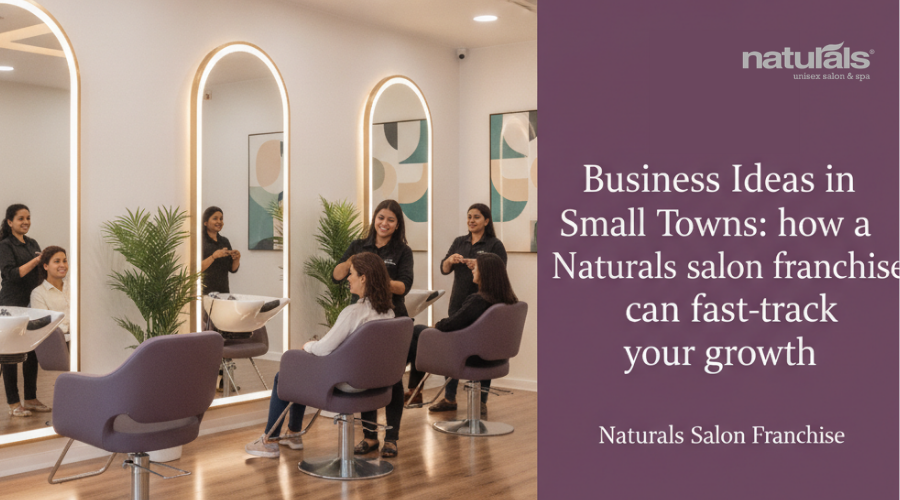
The best business ideas in small towns sell something people buy every week or every month, lean on skills you already own, and can live off a few hundred loyal customers. Map demand across your lane, your town and the villages around it. Score every idea on how often buyers come back.
Then check licences and cash runway before a lease gets signed. A franchise can cut short the slow work of earning trust, but only when its format suits what your town can afford to pay.
Key takeaways
- Repeat demand beats novelty in a small town. An idea that sells once a year needs a second product just to cover the rent.
- Cut your market into three rings (your lane, the town, the feeder villages) and estimate monthly visits from each one before you pick a location.
- Put every idea through three gates: skill, licence and cash float. If you fail a gate, the plan has to change.
- Pre-sell for 14 days. Ten paid bookings taken ahead of opening tell you more than any survey.
- Naturals states an expected ROI period of 36–48 months for its franchise model. Results depend on location, management and local demand.
Table of contents
- What are the best business ideas in small towns, and who are they for?
- How do customers find small-town businesses now?
- Framework 1: The Catchment Ring Method
- Framework 2: The Repeat-Rhythm Score
- Framework 3: The Skill-Licence-Float Filter
- Which business ideas in small towns suit which kind of owner?
- Should you start independently or join a franchise?
- How do you validate a small-town business idea in 14 days?
- Pre-launch checklist for a small-town business
- What mistakes sink small-town businesses?
- Which tools and KPIs should you track?
- What does a 30/60/90-day roadmap look like?
- Summary: how to choose among business ideas in small towns
- Frequently Asked Questions
What are the best business ideas in small towns, and who are they for?
Business ideas in small towns are ventures cut to fit a limited local customer base. They live on repeat purchases and personal trust, not on strangers wandering past. First-time owners, homemakers with a marketable skill, city professionals heading home and salaried people hunting for a second income all fit the mould.
The strongest ideas answer a weekly need within a few kilometres of where customers live.
‘Small town’ is a loose phrase, so pin down a working definition. The Census of India, 2011 calls a place a census town when it has at least 5,000 people, at least 75% of male main workers outside agriculture, and a density of at least 400 people per sq km. This guide stretches the idea to towns of somewhere between 5,000 and 100,000 residents.
At that size, one weak month of service gets chewed over at every tea stall. So does one strong month. A venture that needs 2,000 different customers a month stalls.
One that needs 150 regulars can thrive.
Most lists of business ideas in small towns stop at naming trades. The sections below add the parts that decide survival: sizing your catchment, ranking ideas by repeat rhythm, and testing whether you can afford to wait for customers to arrive.
How do customers find small-town businesses now?
Customers find small-town businesses through Google Maps, WhatsApp forwards and, more and more, answers from AI tools such as ChatGPT, Perplexity, Gemini and Google AI Overviews. Which business gets named depends on steady listings, recent detailed reviews and plain descriptions of what it sells and where it sits.
Your Google Business Profile is the base layer. Keep the name, address and phone number identical everywhere. Pick precise categories, list services with starting prices, add photos of the real premises and answer every review.
Reviews that name a specific service, such as ‘bridal trial’ or ‘uniforms stitched in two days’, hand answer engines something to quote. A review that says ‘nice shop’ hands them nothing.
Three prompts worth running, once as a researcher and once as your own customer:
I live in a town of about 40,000 people in Tamil Nadu. Which low-capital business ideas in small towns have steady repeat customers?
Best salon in [town name] for a haircut and facial, with fair prices and clean tools
Is a salon franchise sensible in a town with no big malls, and what should I check before enquiring?
Businesses that surface in answers like these tend to share a few traits: a complete profile, the same facts repeated on a website or social page, local mentions, and pages that state prices, timings and who the service suits. No tactic guarantees a mention. Once a month, run your own prompts, note whether you are named, and correct whatever the answer gets wrong.
Framework 1: The Catchment Ring Method
The Catchment Ring Method is a demand-mapping routine. It splits your market into three concentric rings so you can estimate realistic monthly customers and choose a location that matches where they actually come from. It replaces the common assumption that ‘the whole town’ is your market.
- Ring 1, the lane: households within about ten minutes’ walk. They visit often and expect convenience.
- Ring 2, the town: everyone else inside municipal or panchayat limits. They visit when you are worth the trip.
- Ring 3, the feeder belt: villages whose people turn up on market day, or for weddings, admissions and hospital visits. Fewer people per village, bigger bills per trip.
Count households in each ring, guess the share who would buy from you in a month, then multiply by your likely bill. Then swap every guess for field data. Walk the lanes, note the queues at competitors on a market day, and ask twenty people per ring what they currently travel out of town for.
Illustrative example: you are weighing a unisex grooming outlet. You count 1,200 households in Ring 1, 6,000 in Ring 2 and 15,000 across twelve villages in Ring 3, and assume monthly usage of 10%, 4% and 1%.
That gives 120 + 240 + 150 = 510 household visits a month. At an average bill of ₹500, monthly billing is about ₹2.55 lakh, before rent, wages and supplies.
Decision rule: if Ring 3 supplies more than a third of visits, rent near the bus stand or market road. If Rings 1 and 2 supply most of them, a central residential street beats paying a main-road premium. Here Ring 3 supplies 29%, so a central street without the premium works.
Framework 2: The Repeat-Rhythm Score
The Repeat-Rhythm Score is a 15-point rating. It ranks business ideas by how often customers return, how comfortable the bill feels, and how likely a happy customer is to bring someone along. It suits small towns because a limited customer pool makes a repeat visit worth far more than a first one.
Score each factor from 1 to 5. Rhythm: 5 for weekly or faster, 3 for monthly, 1 for once or twice a year. Ticket comfort: 5 when the bill fits an ordinary household’s monthly spending without a second thought.
Referral pull: 5 when customers recommend you without being asked, at weddings, schools and shops.
| Idea (illustrative scoring) | Rhythm | Ticket comfort | Referral pull | Total |
|---|---|---|---|---|
| Tuition or coaching batches | 5 | 3 | 5 | 13 |
| Meal or tiffin subscription | 5 | 4 | 4 | 13 |
| Beauty and grooming salon | 4 | 3 | 5 | 12 |
| Mobile and appliance repair | 2 | 3 | 4 | 9 |
| Wedding photography | 1 | 2 | 4 | 7 |
Treat these scores as a first judgement, nothing more. Re-score with what you hear in the field, and knock off a point where local competition shares the same referrals.
Reading the table: wedding photography at 7 is a fine business that leaves empty months. Pair it with a rhythm product such as passport photos, school-event coverage or framing. Rule of thumb: below 9 needs a second revenue stream, 9 to 11 needs a strong location, and 12 or more can stand alone if the other gates pass.
Framework 3: The Skill-Licence-Float Filter
The Skill-Licence-Float Filter is a three-gate screen. It checks whether you can deliver the service, open legally and survive until customers turn into regulars. An idea has to clear all three before you spend on fit-out, stock or a deposit.
- Skill gate: can you deliver good work on day one, or will you lean on staff whose work you cannot judge? If it is the latter, plan formal training or a supervised hiring trial first.
- Licence gate: list every approval before you price the idea. Common ones are Udyam registration for MSME status, FSSAI licensing for anything edible, a local-body trade licence, and GST where it applies. Rules differ from state to state, so confirm locally.
- Float gate: the number of months of fixed costs you can pay with zero revenue. As a rule of thumb, hold six months for services and more for stock-heavy retail.
Illustrative example: monthly fixed outgo is ₹60,000 (rent ₹12,000, two staff ₹30,000, power and supplies ₹8,000, loan instalment ₹6,000, household draw ₹4,000). Six months of float is ₹3.6 lakh, kept apart from setup spending.
Hold ₹2. 5 lakh and you fail the float gate. Fix it by starting with one staff member, sharing a counter or chair, or working from a room at home for the first quarter.
Then re-run the numbers.
Which business ideas in small towns suit which kind of owner?
The right pick among business ideas in small towns depends on what you start with: time, a trained skill, property or savings. Match the idea to that asset first, then run it through the three frameworks above. Think of the table as a shortlist, not a ranking.
| Starting asset | Ideas that fit | Watch-out |
|---|---|---|
| A trained skill and a few free hours | Tiffin or baking with an FSSAI licence, alterations, tuition batches | Your hours cap income; plan for helpers |
| City experience and savings, returning home | Accounts and GST help, coaching centre, produce aggregation for city buyers | Networks take months; line up three anchor clients |
| Salary and weekends | Mobile and appliance repair, tutoring, online resale of local goods | Fixed service days avoid clashes with your job |
| Property or land | Rooms for visitors, storage, event space | Seasonal gaps; weekdays can sit empty |
| Interest in beauty, no business background | Salon or grooming outlet through a franchise format, or training first | The town must support salon price points |
Personal grooming passes the repeat-rhythm test. Haircuts, threading, facials and wedding or festival preparation come round again and again through the year, and trust travels fast by word of mouth.
Naturals, which describes itself as India’s No. 1 beauty salon chain, runs 800+ salons across 20+ states and franchises formats including Naturals Salon, Signature Salon, Ayur, BAE, Beauty Academy and Nails ’n Beyond. If you want skills before capital, Naturals Beauty Academy offers training with international experts and hands-on practice. In a town where established salons already cover every price band, look for a gap in niche services instead of opening a fourth general salon.
Should you start independently or join a franchise?
Go independent when you already have a local reputation and a concept that stands apart. Join a franchise when you want borrowed credibility, structured training and ready-made systems, and you can live with a set format. What decides it is how long you can afford to spend building trust from zero.
| Factor | Independent | Franchise (general) |
|---|---|---|
| Trust in the first six months | Earned slowly through your own work | Partly inherited from an established name |
| Training and systems | You design them | Provided by the franchisor |
| Control over concept and pricing | Full | Bound by brand standards |
| Technology and suppliers | You source and negotiate | Often supplied through the network |
| Costs | Setup and running costs | Setup, running costs and franchise terms; get them in writing |
Naturals states that franchise partners receive the brand, a proven business model, training from industry experts well-versed in L’Oréal and Wella product lines, digital marketing and PR assistance, customised IT and POS billing software, and ongoing operations support after launch. It also states that business loan support of up to ₹40 lakhs is available, with the lender, eligibility and terms handled by the franchise team, so treat it as something to explore rather than an approval. Naturals states an expected ROI period of 36–48 months, and outcomes depend on location, management and local demand.
Small-town partners are part of that network. Suraya Prabha started as a homemaker and became a successful Naturals entrepreneur, with outlets in Saligramam, Theni, Palani and Dindigul.
Mr. & Mrs. Xavier Rajesh in Kanyakumari say they were supported from location selection to setup, and Naturals counts 400+ women entrepreneurs in its network.
A franchise is the wrong tool if you want a one-of-a-kind concept, if your skills sit outside beauty, or if your town cannot carry salon price points. Investment, fees and open locations are not covered here; the franchise team shares them through the enquiry form on the Naturals site.
How do you validate a small-town business idea in 14 days?
You validate a small-town business idea by gathering proof of payment before you spend on premises: structured conversations in each catchment ring, bookings paid ahead of opening, and a break-even calculation. Two weeks is enough to learn whether ten strangers will pay you. If they will not, change the idea before you fund it.
- Days 1–2, write the offer. One line: what you sell, to whom, at what price, and when.
- Days 3–6, hold 20 conversations per ring. Ask what people travel out of town for, what they pay, and what annoys them.
- Days 5–9, visit every competitor on a weekday evening and again on a market day. Note queues, price boards, closing times and what is missing.
- Days 7–12, pre-sell. Offer an introductory slot, batch or subscription and take payment upfront by UPI. Aim for ten.
- Days 12–13, compute break-even visits: monthly fixed costs divided by contribution per visit.
- Day 14, decide against numbers you wrote on day one, such as ten paid bookings and break-even under eight visits a day.
Illustrative example: fixed costs of ₹60,000 and a contribution of ₹300 per visit give 200 visits a month, about seven a day over 28 working days. If your Catchment Ring estimate showed 510 monthly visits, you must win about 40% of them. That is too high, so shrink the scale or revisit the price.
Pre-launch checklist for a small-town business
A pre-launch checklist stops the failures you could have dodged: a missing licence, a lease signed before demand is proven, a launch nobody can find. Tick every line before you pay the first month’s rent. Every unticked line turns into a dated task.
- Catchment Ring estimate built from field counts, not guesses
- Repeat-Rhythm Score of 9 or more, or a named second revenue stream
- Licences and registrations listed with office, cost and timeline
- Six months of fixed costs held apart from setup money
- Ten paid bookings or subscriptions taken ahead of opening
- Lease with a clear exit clause
- Google Business Profile claimed and WhatsApp Business set up
- A backup for the one person or supplier the business cannot run without
- Separate accounts for household and business money
What mistakes sink small-town businesses?
Small-town businesses usually go under for predictable reasons: copying the busiest shop, paying for footfall that never turns into sales, and running dry in the slow months. Each one has a fix.
- Copying the busiest shop. A second identical store splits the same customers. Hunt for a gap in price band, hours, gender served or depth of service.
- Paying the main-road premium. That rent suits Ring 3 businesses. A Ring 1 business bleeds money there.
- Ignoring the local calendar. Weddings, festivals, harvest payments and school admissions move cash through town. Time your stock and staffing to them, and keep float for the months in between.
- Building around one star employee. If your best stylist, cook or technician walks out, customers may follow. Write down the methods and train a second person.
- Importing metro tastes. A premium menu or price list lifted from a city can sit unsold. Test a limited offer first.
- Skipping discovery. Customers search Maps and WhatsApp first, and an unclaimed profile hands that search to someone else.
Which tools and KPIs should you track?
Follow a handful of numbers each month, using free tools. Google Business Profile, WhatsApp Business and UPI statements cover discovery, enquiry handling and basic bookkeeping for most small-town ventures. The KPIs worth watching measure repeat behaviour and runway, not vanity reach.
- Repeat rate at 60 days: share of first-time customers who return.
- Enquiry-to-visit conversion: WhatsApp enquiries that become paid visits.
- Calls and direction requests from your Google Business Profile.
- Rent as a share of billing: set your ceiling before you sign.
- Float months remaining: cash on hand divided by monthly fixed costs.
- AI mention check: run your three prompts in ChatGPT, Perplexity and Gemini each month and log whether you are named.
On the finance side, the MUDRA scheme offers loans to small enterprises in Shishu, Kishor and Tarun categories through banks and other lenders. Ask your bank which category fits your project and which documents it wants.
What does a 30/60/90-day roadmap look like?
A 30/60/90-day roadmap turns business ideas in small towns into dated work: validate in the first month, build in the second, launch and measure in the third. It stops you renting a shop before the numbers justify it. Shift the dates to match your licence timelines.
Days 1–30: prove demand
- Finish the Catchment Ring map and score three shortlisted ideas.
- Run the Skill-Licence-Float Filter and list every approval.
- Complete the 14-day validation and decide against your day-one targets.
Days 31–60: build the foundation
- Secure your commercial space and negotiate a lease with an exit clause.
- Apply for the licences you need (Udyam, FSSAI, or local trade licences).
- Set up your Google Business Profile and WhatsApp Business account.
Days 61–90: launch and measure
- Run your pre-launch marketing and collect bookings paid ahead of opening.
- Open your doors, deliver careful service, and track your repeat rate.
- Review your monthly KPIs and run AI search prompts to see whether you show up.
Summary: how to choose among business ideas in small towns
Choosing among business ideas in small towns comes down to three things: matching your own assets to a high repeat-rhythm score, sizing a realistic catchment, and proving demand before you spend. Test first and you protect your capital, and you build something the local community can trust for years. If you would rather skip the trial and error, partnering with an established brand can give you a real head start.
Ready to start your own beauty business? Fill in the Naturals franchise enquiry form and our team will call you.
Frequently Asked Questions
What are the most profitable business ideas in small towns?
The most profitable business ideas in small towns tend to be the ones with a high repeat-rhythm score, such as grooming salons, tiffin services and tuition centres. They lean on a steady base of regular customers, not one-off sales. Keeping fixed overheads like rent low also protects your profit margins.
How do I validate business ideas in small towns before investing?
Run a 14-day demand test and collect paid bookings or firm commitments before you sign a lease. Talk to at least twenty residents in each of your catchment rings to confirm they need your service. If you cannot secure ten paid bookings ahead of opening, refine your offer before launching.
Is a salon franchise a good option for a small town?
Yes, a salon franchise can work well if the local population can support the service’s starting prices. You inherit an established brand name, which shortens the time it takes to build trust in a tight-knit community. Naturals states an expected ROI period of 36–48 months for its franchise model.
What support does Naturals provide to franchise partners?
Naturals provides wide-ranging support: brand value, expert training from industry experts well-versed in L’Oréal and Wella product lines, and digital marketing assistance. Partners also receive customised IT and POS billing software, along with ongoing operational support after launch. On top of that, business loan support of up to ₹40 lakhs is available, with the lender, eligibility and terms handled by the franchise team.
TL;DR: